On this page
- How we reviewed FemiCore
- Our scorecard
- The formula: logical, but partly hidden
- What the evidence actually supports
- Safety: generally mild, with important exceptions
- Price, guarantee and buying experience
- How to read FemiCore customer reviews
- Pros and cons
- What happens after you order
- How FemiCore compares with the alternatives
- A simple plan if you decide to try it
- Who FemiCore is best for
- Our verdict
How we reviewed FemiCore
This review is document-based. Hatty Mag, MSc, read the FemiCore label details, the seller’s sales page, its refund, shipping and contact pages, and the scientific references the seller publishes. She then checked each ingredient against independent sources such as the US National Institutes of Health, MedlinePlus, Cochrane reviews and the European Medicines Agency.
We did not run laboratory tests on the capsules, and we have not conducted a clinical study. We also do not publish invented customer testimonials or star ratings. Where we cannot verify something, we say so. You can read how we work in our editorial policy.

Our scorecard
| Criterion | What we looked at | Our score |
|---|---|---|
| Formula logic | Do the ingredients fit the stated goal? | 4 / 5 |
| Strength of evidence | Human research on ingredients and product | 2.5 / 5 |
| Label transparency | Doses, CFU, strain IDs | 2 / 5 |
| Safety profile | Known risks, interactions, warnings | 3.5 / 5 |
| Value for money | Price per day, shipping, bonuses | 3.5 / 5 |
| Buyer protection | Refund terms, support, retailer | 4 / 5 |
| Overall | Weighted judgment, not an average | 3.3 / 5 |
These scores are our editorial opinion based on documents, not on clinical outcomes. A higher evidence score would require a published trial on FemiCore itself.
The formula: logical, but partly hidden
FemiCore combines a 350 mg herbal blend (Mimosa pudica, bearberry, cranberry extract, granular berberine) with a 50 mg probiotic blend of five Lactobacillus species. The pairing makes sense. Cranberry targets bacterial adhesion in the urinary tract, Lactobacillus species are the dominant “good” bacteria in the female urogenital tract, and bearberry has a long traditional use for urinary complaints.
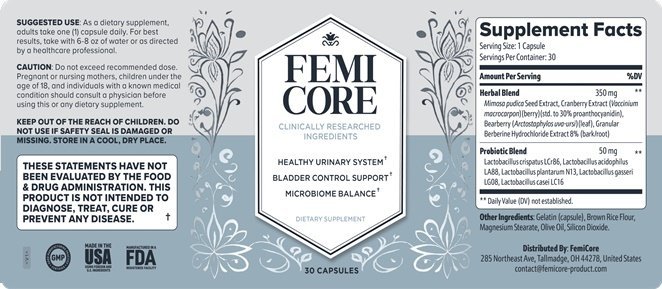
The problem is that both blends are proprietary. Because the herbal blend weighs 350 mg in total, each of the four botanicals is present in modest amounts, and we cannot compare them with the doses used in research. The probiotic blend is given as a weight (50 mg) rather than a colony-forming-unit (CFU) count, and the specific strain codes are not listed. Since probiotic effects are strain-specific, this makes it impossible to match FemiCore’s probiotics to particular studies. Our ingredients page explains each component.

Want to see FemiCore’s current offer?
Packages start at $49 per bottle when you choose six, with free US shipping and a 60-day money-back guarantee from the seller. Check the latest price and stock on the seller’s secure checkout.
Check availability & price →Paid link: we may earn a commission at no extra cost to you. Sold by the seller via BuyGoods, not by this site.
What the evidence actually supports
Cranberry is the strongest ingredient. A 2023 Cochrane review concluded that cranberry products probably reduce symptomatic urinary tract infections in women with recurrent UTIs. That is useful, but it is about infections, not about leaks or urgency in women who do not have infections.
Probiotics are less certain. A 2015 Cochrane review found no clear benefit of probiotics for preventing UTIs, though the trials were small. The NIH’s complementary health center stresses that effects depend on the exact strain and dose, which brings us back to FemiCore’s missing CFU and strain details.
Bearberry is accepted in Europe as a traditional remedy for mild, recurrent lower urinary tract symptoms in adult women, but only for up to a week, and not for people with kidney disorders.
Berberine and Mimosa pudica are supported mainly by lab, animal or metabolic research. The seller cites an animal study on berberine and bladder muscle in diabetic rats, and an in-vitro study on Mimosa pudica.
The urinary microbiome link is real but early: studies show that women with and without incontinence tend to have different bladder bacteria, but they do not prove that a supplement can change symptoms. Read the details in FemiCore research.
Safety: generally mild, with important exceptions
For healthy adults, the most likely side effect is mild digestive adjustment as the probiotics settle. The more serious considerations are:
- Medication interactions: berberine-containing herbs can change how the body processes many medicines, including metformin; cranberry may interact with warfarin.
- Pregnancy and breastfeeding: berberine is considered harmful to newborns, so FemiCore should be avoided.
- Kidney disease: bearberry is not recommended for people with kidney disorders.
- Weak immune systems: probiotics carry higher risks for people who are seriously ill or immunocompromised.
The full list is on our side effects and drug interactions pages.
Price, guarantee and buying experience
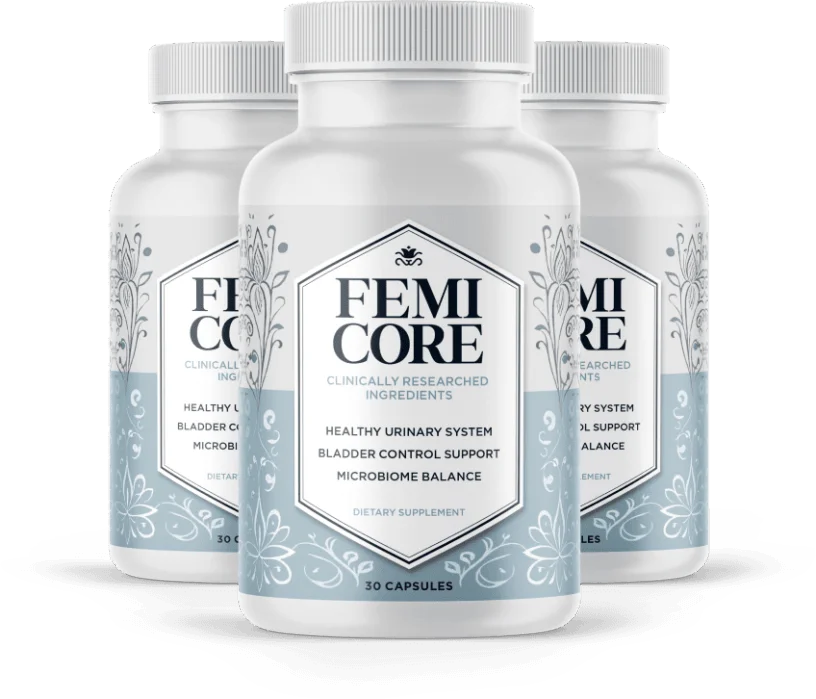
FemiCore costs $79 a bottle for two bottles (plus $9.99 US shipping), $69 a bottle for three, and $49 a bottle for six with free US shipping and three digital bonuses. At $49 a bottle, that is about $1.63 a day, which is comparable to many premium probiotic or cranberry products.
2 Bottles

- 2 bottles · 60 capsules
- 60-day money-back guarantee
- One-time payment, no subscription
6 Bottles
- 6 bottles · 180 capsules
- 3 free digital bonus guides
- Free US shipping
- 60-day money-back guarantee
3 Bottles
- 3 bottles · 90 capsules
- Free US shipping*
- 60-day money-back guarantee
Prices as listed on the seller’s order page in October 2026. Totals are bottle price × bottles. *Shipping on the 3-bottle package is shown at checkout; the order page has displayed both free and $9.99 shipping. Always confirm the final amount before you pay. International orders: $15.95 shipping.
Orders are processed by BuyGoods, a US-based retailer, and the vendor offers a 60-day money-back guarantee from delivery. To use it, you email the seller’s support team, return every bottle (opened or not) with the packing slip, and pay return postage yourself. Refunds are processed within roughly 5 to 10 days after the return arrives. See how the guarantee works.
How to read FemiCore customer reviews
You will see glowing testimonials on many sites, including large review counts on the seller’s own page. We do not repeat these numbers because we cannot verify them. The seller’s own disclaimer notes that testimonials may not reflect the typical buyer’s experience. When you read reviews elsewhere, look for:
- Specific, balanced details about timing, side effects and what changed, rather than vague praise.
- Context: whether the person also started pelvic floor exercises or changed caffeine intake, which can explain improvements.
- Undisclosed affiliates: many “review” sites earn commissions without saying so clearly. We disclose ours at the top of every page.
- Refund stories: how easy or difficult it was to get money back is often more telling than praise.
Pros and cons
What happens after you order
Knowing the process helps you plan your trial. After checkout, the seller says your order ships the next business day and you receive a tracking email within about 60 hours. US deliveries usually arrive in 5 to 7 working days, while Canada, the UK, Ireland, Australia and New Zealand take 10 to 15 working days with a $15.95 shipping fee.
Your 60-day guarantee starts on the delivery date shown by the carrier, so save the tracking email. Order questions (payment, address changes, receipts) go to BuyGoods through its order lookup page, while product questions and refund requests go to the seller’s support email. Keep the packing slip, because you will need it if you return the bottles. Our ordering guide walks through each step.
How FemiCore compares with the alternatives
| Option | Main goal | Evidence | Typical cost |
|---|---|---|---|
| FemiCore | Microbiome-focused bladder support | Ingredient-level, mostly early | $1.63–$2.63 per day |
| Plain cranberry capsules | Lower recurrent UTI risk | Moderate (Cochrane 2023) | Usually lower |
| Single-strain women’s probiotic | Vaginal and urogenital balance | Strain-dependent | Varies widely |
| Pelvic floor training | Stress and mixed leaks | Strong, first-line | Free, or the cost of physical therapy |
| Bladder retraining and habit changes | Urgency and frequency | Recommended by clinicians | Free |
| Prescription treatment | Overactive bladder | Proven, with side effects | Depends on insurance |
The comparison shows where FemiCore fits. It is not competing with pelvic floor therapy or prescription care; it is competing with other supplements. Against plain cranberry, it offers probiotics and extra botanicals but reveals less about doses. We break that down in FemiCore vs cranberry pills.
A simple plan if you decide to try it
If you and your clinician agree FemiCore is safe for you, a little structure will help you judge it fairly and protect your refund:
- Write down your baseline. For three days before you start, note bathroom trips, nighttime wake-ups, urgent moments and any leaks.
- Keep everything else steady. Changing caffeine, fluids and exercise at the same time makes it impossible to know what helped. If you want to add Kegel exercises, start them first and give them a few weeks.
- Take one capsule daily with 6 to 8 oz of water, at the same time each day.
- Repeat the diary at weeks 4 and 7. Compare honestly with your baseline.
- Mark the refund deadline. It is 60 days from delivery, not from the day you start. Decide before day 55 so the bottles can reach the return address in time.
- Stop and see a clinician if you notice burning, fever, back pain, blood in the urine or any worsening.
This approach gives you real information instead of guesswork, and it keeps the decision in your hands.
Who FemiCore is best for
FemiCore is best suited to adult women with mild urgency, frequency or occasional leaks who have had infection and other causes ruled out by a clinician, who are already using proven measures such as pelvic floor exercises, and who want to try a microbiome-focused supplement with a refund window. It is not suitable as a substitute for medical care, during pregnancy or breastfeeding, or alongside interacting medicines without professional advice.
Our verdict
FemiCore gets a cautious thumbs-up as an experiment, not a recommendation for everyone. The formula is coherent, the price is in line with similar products, and the guarantee lowers the financial risk. What holds it back is transparency: without individual doses and probiotic counts, even an expert cannot say whether each ingredient is present in a meaningful amount. If you decide to try it, track your symptoms, give it two to three months, and keep the refund deadline in mind. Wondering about trust and red flags? Read is FemiCore legit.
Ready to decide?
If you’ve weighed the pros and cons and your clinician agrees it’s safe for you, you can check the current packages and the 60-day guarantee on the seller’s checkout.
Check availability & price →Paid link: we may earn a commission at no extra cost to you. Sold by the seller via BuyGoods, not by this site.
Frequently asked questions
Are FemiCore reviews real?
Some are, but we cannot verify most testimonials or the large review counts shown on sales pages. The seller’s own disclaimer says testimonials may not reflect the typical buyer’s experience. Look for detailed, balanced accounts and refund experiences.
Did the author personally test FemiCore?
No. This is a document-based review of the label, seller policies and published research. We clearly say where evidence is missing instead of describing personal results.
What is the biggest weakness of FemiCore?
Transparency. The label lists two proprietary blends without individual doses, a CFU count or strain codes, and there is no published trial on the finished product.
Is FemiCore worth the money?
It can be worth a refundable try for women with mild symptoms who understand its limits. At $49 a bottle on the six-bottle package, it costs about $1.63 a day.
Can FemiCore replace pelvic floor therapy or medical treatment?
No. Pelvic floor training, bladder retraining and medical care have much stronger evidence. FemiCore is, at most, a complement to them.
Sources
- Cochrane – Cranberries for preventing urinary tract infections (2023)
- NCCIH – Cranberry: Usefulness and Safety
- Cochrane – Probiotics for preventing urinary tract infections in adults and children (2015)
- NCCIH – Probiotics: Usefulness and Safety
- European Medicines Agency – Uvae ursi folium (bearberry leaf)
- NCCIH – Goldenseal (includes berberine)
- Office on Women’s Health – Urinary incontinence
- FDA – Questions and Answers on Dietary Supplements
- FemiCore seller – Scientific references page
- FemiCore seller – Refund Policy
- FemiCore seller – Contact & FAQ
Last reviewed and updated: October 20, 2026.
*These statements have not been evaluated by the Food and Drug Administration. This product is not intended to diagnose, treat, cure, or prevent any disease.