On this page
- How to weigh supplement research
- Evidence summary by ingredient
- Cranberry: the strongest link
- Probiotics: promising, but not yet proven for the urinary tract
- Bearberry: traditional use with clear limits
- Berberine and Mimosa pudica: early science
- The microbiome research
- About the seller’s reference list
- What would better evidence look like?
- The bottom line
How to weigh supplement research
Not all studies carry the same weight. From strongest to weakest, the general hierarchy is: systematic reviews of randomized trials, individual randomized controlled trials, observational studies in people, animal studies, and test-tube (in vitro) studies. Traditional use is a separate category, useful for safety history but not proof of effect. We use this scale throughout.
Evidence summary by ingredient
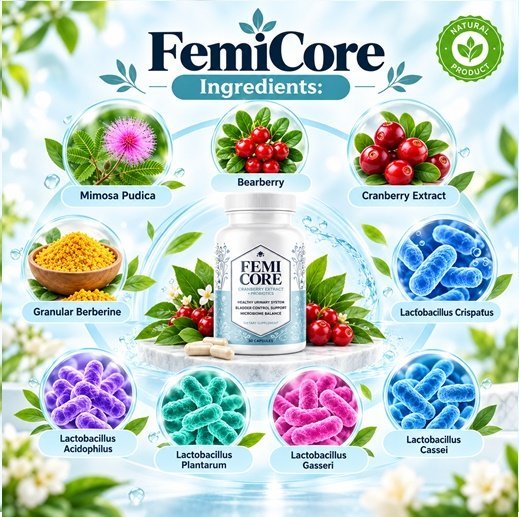
| Ingredient | Best available evidence | What it shows | Relevance to FemiCore |
|---|---|---|---|
| Cranberry | Cochrane systematic review (2023) | Probably reduces symptomatic UTIs in women with recurrent UTIs | Strong for UTI risk, not for leaks; dose unknown |
| Probiotics (general) | Cochrane systematic review (2015) | No clear reduction in UTIs; small, varied trials | Strain and dose matter; FemiCore discloses neither |
| Bearberry | EU traditional-use monograph | Traditional use for mild lower urinary tract symptoms, max 1 week | Long-term use not covered |
| Berberine | Animal and metabolic studies | Effects on microbes, metabolism; rat bladder study | Human bladder data lacking |
| Mimosa pudica | In-vitro studies | Antimicrobial and antioxidant activity in the lab | Human data lacking |
| Urinary microbiome | Observational studies | Microbiome differs in women with incontinence | Association, not causation |
Cranberry: the strongest link
The 2023 Cochrane review on cranberries concluded with moderate certainty that cranberry products probably reduce the risk of symptomatic, culture-verified UTIs in women with recurrent UTIs, in children, and in people susceptible after bladder interventions. It found little or no benefit in elderly people in care homes, pregnant women, and adults with bladder-emptying problems. NIH adds that cranberry is not a treatment for an active infection. See cranberry extract.

Want to see FemiCore’s current offer?
Packages start at $49 per bottle when you choose six, with free US shipping and a 60-day money-back guarantee from the seller. Check the latest price and stock on the seller’s secure checkout.
Check availability & price →Paid link: we may earn a commission at no extra cost to you. Sold by the seller via BuyGoods, not by this site.
Probiotics: promising, but not yet proven for the urinary tract
The 2015 Cochrane review found no significant reduction in UTIs with probiotics compared with placebo or no treatment, while noting that the studies were few, small and poorly reported, so a benefit cannot be ruled out. NIH stresses that probiotic effects depend on the specific strain and dose and that it is often unknown which products help. FemiCore’s label lists species, not strains, and a weight, not a CFU count. See our pages on each probiotic, starting with L. crispatus.
Bearberry: traditional use with clear limits
The European Medicines Agency’s herbal committee concluded that bearberry leaf preparations can be used for symptoms of mild, recurrent lower urinary tract infections in adult women, on the basis of traditional use rather than clinical trials. Use should not exceed one week, and people with kidney disorders must not take it. The seller also cites a clinical trial protocol (the BRUMI study) designed to test bearberry for acute cystitis, which is a plan for research rather than results.
Berberine and Mimosa pudica: early science
The seller’s references include a rat study showing berberine affected bladder muscle responses in diabetic animals, and a lab study on Mimosa pudica extracts showing antibacterial and antioxidant activity. These are reasonable starting points for research, but they cannot tell us what happens in women taking a small amount in a capsule. NIH also notes that very little berberine may be absorbed when taken by mouth.
The microbiome research
The seller’s reference list leans on studies of the urinary microbiome in women, including work from the US Pelvic Floor Disorders Network comparing women with mixed incontinence with similar-aged controls, and studies linking microbial community types with incontinence severity. These studies are high-quality observational research, and they are why the field is exciting. They do not test interventions.
About the seller’s reference list
We reviewed the seller’s published references. Alongside microbiome and ingredient studies, it includes news articles about tampon safety and toxins, which are not relevant to FemiCore’s effects. We also noticed that the reference page shows labels for other products. This does not make the product unsafe, but it is a reminder to read the evidence critically.
What would better evidence look like?
A randomized, placebo-controlled trial of FemiCore in women with urgency or mixed incontinence, using validated symptom questionnaires and bladder diaries for at least 12 weeks, would answer the key question. Until then, the most honest description is “plausible, ingredient-level support.”
The bottom line
FemiCore’s science story is coherent but incomplete. If you want the best-evidenced approach to bladder control, start with pelvic floor exercises and talk to a clinician. If you choose to try FemiCore as an add-on, go in with realistic expectations and use the 60-day guarantee as your safety net.
Ready to decide?
Packages start at $49 per bottle when you choose six, with free US shipping and a 60-day money-back guarantee from the seller. Check the latest price and stock on the seller’s secure checkout.
Check availability & price →Paid link: we may earn a commission at no extra cost to you. Sold by the seller via BuyGoods, not by this site.
Frequently asked questions
Has FemiCore been clinically tested?
We found no published clinical trial on the finished FemiCore product. The research relates to individual ingredients.
Which FemiCore ingredient is best supported by science?
Cranberry. A 2023 Cochrane review found it probably reduces symptomatic UTIs in women with recurrent infections.
Do probiotics prevent urinary tract infections?
The 2015 Cochrane review found no clear reduction, though trials were small. Effects depend on the specific strains and doses used.
Sources
- Cochrane – Cranberries for preventing urinary tract infections (2023)
- NCCIH – Cranberry: Usefulness and Safety
- Cochrane – Probiotics for preventing urinary tract infections in adults and children (2015)
- NCCIH – Probiotics: Usefulness and Safety
- European Medicines Agency – Uvae ursi folium (bearberry leaf)
- NCCIH – Goldenseal (includes berberine)
- FemiCore seller – Scientific references page
Last reviewed and updated: October 20, 2026.
*These statements have not been evaluated by the Food and Drug Administration. This product is not intended to diagnose, treat, cure, or prevent any disease.