On this page
The FemiCore label in brief
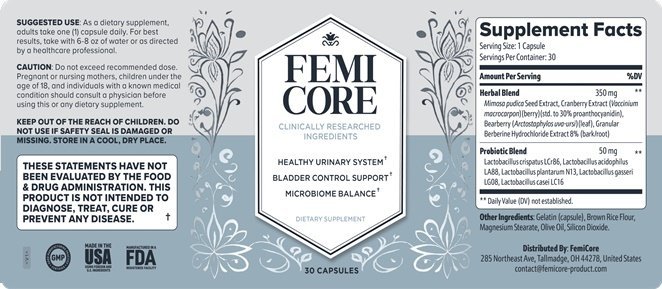
| Label item | Detail |
|---|---|
| Serving size | 1 capsule |
| Servings per bottle | 30 |
| Directions | 1 capsule daily with 6–8 oz (180–240 ml) of water |
| Herbal blend | 350 mg |
| Probiotic blend | 50 mg |
| Warnings | Do not exceed the recommended dose; pregnant or nursing women and anyone under 18 should consult a doctor |
Herbal blend (350 mg)
| Ingredient | Main reason it is included | Evidence level | Key caution |
|---|---|---|---|
| Mimosa pudica | Traditional herb; antimicrobial activity in the lab | In vitro | Little human safety data |
| Bearberry (uva ursi) | Traditional urinary herb | Traditional use (EU) | Short-term use; not with kidney disorders |
| Cranberry extract | PACs that may reduce bacterial adhesion | Cochrane review, moderate | Warfarin (evidence mixed) |
| Granular berberine | Antimicrobial and metabolic effects | Lab, animal, metabolic | Many drug interactions; pregnancy |
The four botanicals share 350 mg. Even if they were split evenly, each would be under 90 mg, though the true split is unknown. Many studies of these botanicals used larger amounts, which is worth keeping in mind.
Probiotic blend (50 mg)
| Ingredient | Natural home | Why it is included | Evidence level |
|---|---|---|---|
| L. crispatus | Healthy vaginal microbiome | Headline strain for female urogenital health | Early clinical |
| L. acidophilus | Gut, vagina, fermented dairy | Well-known general probiotic | Mixed |
| L. plantarum | Fermented plant foods | Hardy strain; small urinary pilot studies | Early |
| L. gasseri | Vagina and gut | Common in healthy female microbiomes | Early |
| L. casei | Fermented dairy, gut | General gut support | Limited for bladder |
The blend is labeled by weight. A probiotic’s weight includes the bacteria and the material they are dried with, so 50 mg tells us little about how many live organisms you get. Most quality probiotic labels state a CFU count guaranteed through the expiry date, along with strain codes (for example, a letter-and-number code after the species name). FemiCore’s label shows neither.

Want to see FemiCore’s current offer?
Packages start at $49 per bottle when you choose six, with free US shipping and a 60-day money-back guarantee from the seller. Check the latest price and stock on the seller’s secure checkout.
Check availability & price →Paid link: we may earn a commission at no extra cost to you. Sold by the seller via BuyGoods, not by this site.
A note on new probiotic names
In 2020 scientists reorganized the large Lactobacillus group into several genera. Some FemiCore species now have new official names: L. plantarum is Lactiplantibacillus plantarum, and L. casei is Lacticaseibacillus casei. L. crispatus, L. acidophilus and L. gasseri remain in Lactobacillus. Labels and websites often still use the older names, as FemiCore does.
What the label does not tell you
- The amount of each botanical, including how much cranberry or how many PACs
- The extract ratio or standardization of any herb
- The CFU count and strain codes of the probiotics
- Capsule shell material (relevant for vegetarians and vegans)
- Any allergen information beyond the ingredient list
None of this means the product is poor quality. It does mean you are trusting the formulator’s choices without being able to check them against research. For a balanced view, read our FemiCore research summary.
Ingredients that may matter for your safety
Berberine can interact with several medicines and is unsuitable in pregnancy and breastfeeding. Bearberry is normally advised for short-term use only and not for people with kidney disorders. Probiotics need caution in people with weakened immune systems. Cranberry may interact with warfarin. See side effects and drug interactions.
How the ingredients are meant to work together
The formula follows a simple logic: probiotics support the “good” bacteria that dominate a healthy female urogenital tract; cranberry makes it harder for some bacteria to cling to the bladder wall; bearberry, berberine and Mimosa pudica add traditional and antimicrobial support. You can read the full theory on how FemiCore works.
How to read any supplement label
When comparing FemiCore with other products, look at three things: whether each ingredient’s amount is listed, whether probiotics have strain codes and a CFU count guaranteed until expiry, and whether the brand shares third-party testing results. These details let you, your pharmacist or your doctor judge a product on evidence rather than marketing.
Our overall ingredient assessment
FemiCore’s ingredient choices are coherent and recognizable to anyone familiar with women’s urinary supplements. Cranberry gives it one well-supported component. The probiotic selection is sensible, with L. crispatus and L. gasseri being species typically found in healthy female microbiomes. The main weaknesses are the undisclosed doses and the inclusion of bearberry in a product intended for months of daily use. Click any ingredient above for a full profile.
Ready to decide?
Packages start at $49 per bottle when you choose six, with free US shipping and a 60-day money-back guarantee from the seller. Check the latest price and stock on the seller’s secure checkout.
Check availability & price →Paid link: we may earn a commission at no extra cost to you. Sold by the seller via BuyGoods, not by this site.
Frequently asked questions
What is in FemiCore?
A 350 mg herbal blend (Mimosa pudica, bearberry, cranberry extract, granular berberine) and a 50 mg probiotic blend (L. crispatus, L. acidophilus, L. plantarum, L. gasseri, L. casei).
How many CFU does FemiCore have?
The label does not state a CFU count. It lists the probiotic blend by weight (50 mg).
Does FemiCore contain D-mannose or vitamin C?
No. Neither is listed among FemiCore’s ingredients.
Is FemiCore gluten-free or vegan?
The seller does not publish detailed allergen or capsule-shell information. Contact the seller’s support team if this matters to you.
Sources
- Cochrane – Cranberries for preventing urinary tract infections (2023)
- NCCIH – Cranberry: Usefulness and Safety
- European Medicines Agency – Uvae ursi folium (bearberry leaf)
- NCCIH – Goldenseal (includes berberine)
- NCCIH – Probiotics: Usefulness and Safety
- Cochrane – Probiotics for preventing urinary tract infections in adults and children (2015)
- FemiCore seller – Scientific references page
Last reviewed and updated: October 20, 2026.
*These statements have not been evaluated by the Food and Drug Administration. This product is not intended to diagnose, treat, cure, or prevent any disease.